 |
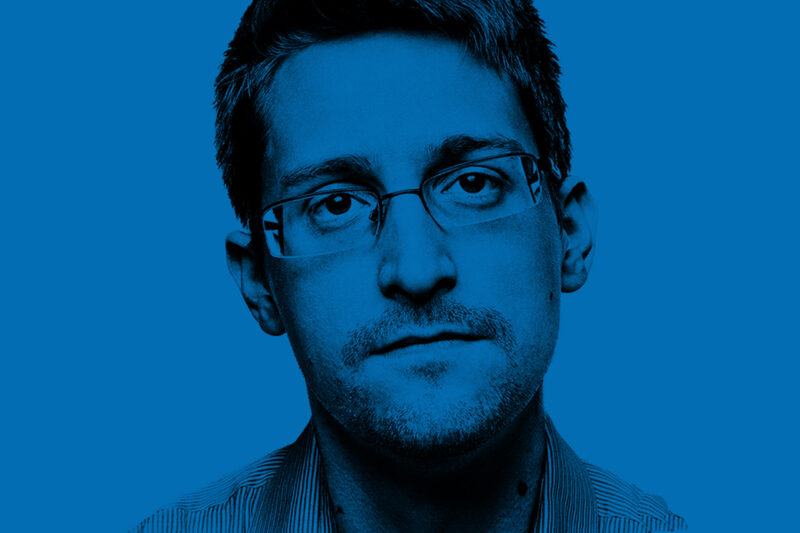
| Image from ACLU |
Less than 2 months after the September 11th terrorist attacks on the world trade center the US congress passed The Patriot Act which broadly and vaguely expanded the authority of government agencies, like the NSA, to spy on ordinary citizens for the purpose of counter-terrorism. The extent to which this surveillance was being carried out would be revealed by multiple whistleblowers and news outlets in the years following. One such whistle blower was former intelligence contractor Edward Snowden who in 2013 leaked to The Guardian that the NSA was collecting phone records on a massive scale under section 215 of the patriot act. The fallout from these leaks resulted in huge changes in American surveillance policy, discussion around digital privacy, and the personal life of Snowden himself when it was revealed in June of 2013 that he was the source of the many leaks published by the Guardian and other news outlets.
Now Snowden lives in Russia as a full citizen where he remains safe from extradition to the United States, where he is charged with violation of the 1917 espionage act and theft of government property. Many in the US view Snowden as a brave patriot who put his freedom at risk for the rights of ordinary citizens, others view him as a coward who carelessly put national security in jeopardy. Despite being 10 years ago the debate about what should be done about Edward Snowden remains, should he be pardoned and allowed to return home for bringing the invasive ways that the government spies on us to our attention, or should he be prosecuted for knowingly breaking the law?
Snowden's intelligence work began in 2006 as an IT expert for the CIA where he would remain until 2012 after one of his supervisors had suspected him of trying to open classified files that he was not authorized to access. After leaving the CIA he found work at Dell as a contractor for the NSA with top-secret clearance, it would be in this position that Snowden would obtain some of the information that he would end up sharing with Guardian columnist Glenn Greenwald in 2013. Later in 2013 after his first anonymous leaks to the press he would leave Dell to work at a firm called Booz Allen Hamilton in order to find new information to leak, later that year he would be fired when the Guardian revealed him as the one behind the NSA leaks.
The content of Snowden's leaks were primarily concerned with data mining done by the NSA which is the massive collection of private and public information of individuals in order to generate leads in counter-terrorism investigations. Data mining works by looking at the metadata of digital records which could be seen without opening or looking at the content of the records themselves. Things like timestamps, locations, file sizes, senders and recipients could all be looked at legally without a warrant and then sorted and analyzed by computer programs that could be shared with other government agencies such as the FBI, CIA, or DOD upon request and approval from a secret Foreign Intelligence Surveillance Judge.
One method of data collection, known by its code name PRISM, gave the NSA access to the the servers of tech giants like Microsoft, Google, Apple, and Facebook and allowed the NSA to collect troves of content and metadata belonging to users for the purpose of data mining. This data collection was done with the assistance of these tech companies however when asked directly they were adamant that they had no involvement or knowledge of the program. PRISM was first made known to the public by the Guardian and the Washington Post who obtained a leaked slideshow that had been shared with them by Edward Snowden. Another, much more powerful and invasive system known as XKEYSCORE, also leaked by Snowden, works by intercepting internet traffic as it runs through fiber optic cables. This method allows the NSA to capture any data it seeks to collect in its entirety which essentially anything one user may send to another.
The Snowden NSA leaks shocked many and shaped public discourse around digital privacy. Despite causing a shift in how the public viewed government surveillance the effects of Snowden's leaks on policy were nominal. Many challenges to the most invasive parts of the Patriot act and FISA were already being challenged in the courts before Snowden had leaked anything, ultimately the leaks created a spectacle that emboldened privacy activists and pressured the government to be more transparent with its surveillance methods.
Edward Snowden did nothing wrong. He had the courage to sacrifice his well being because he believed the public was being spied on by the NSA without any meaningful checks on their power. Through hindsight we know that the leaks have caused no damage to national security, so why does he need to be punished in addition to being forced to flee the country? Since Snowden is now a full citizen of Russia it seems that any chance of him being allowed back in the United States without being instantly arrested is slim, but a pardon or commuted sentence for Snowden is not outside the realm of possibility either if we look at previous examples of notable whistleblowers such as Chelsea Manning. While this may sound pessimistic I don't think Edwards situation will change anytime soon, especially as the public discussion of digital privacy shifts from concerns over use by the government to use by tech companies.
This is Andrew Huang
ReplyDeleteNice write-up on Snowden and why he should be pardoned! Something that confuses me a bit though is what things done by the NSA were legal or illegal. It says that looking at metadata like timestamps, locations, etc. can be done “legally without a warrant,” so I’m just a little confused as to what was legal or illegal or if this was more of a moral issue. But in any case, I’d agree that what Snowden did had benefits for many Americans.
I think most of the things that were mined were done so legally, though that doesn't mean much when the government doing the data collection is also the one that determines the law. I cant speak for every American but for me this is more of a moral issue, one of whether we are okay with our government not only spying on "enemies of the state" but also regular citizens. Personally I'm not sure a pardon really matters in the grand scheme of things, even if he was pardoned I'm not sure he would return to the united states, though it would allow him to more openly travel to countries that would extradite to the US. Personally I believe what he did was right, and whistleblowers should generally not be held to the same standards of non-disclosures or anti-espionage laws if what they disclose is for the public good.
DeleteYes it was all legal, done using powers giving to the NSA by the Patriot and FISA acts.
DeleteI think we should leave him alone. The real reasons any action would be taken against him would obviously me to persecute him, and because this hasn’t happened yet, there is nothing for us to do. He is a hero of many, especially me in many respects because of what he has accomplish and leaked and so I think the public consensus of his actions carries a good sentiment.
ReplyDeleteI do think that Edward Snowden, and other whistle blowers, provide a great benefit to our country. Our government is meant to run on checks and balances, but if the actions of an agency are kept secret from everyone except for those directly involved, it is difficult to tell if there are any checks being placed on it. Even if the information Snowden leaked didn't have a huge impact on reform, I still think that it is important that the American people were made aware of how much information the NSA was collecting.
ReplyDeleteThe part about the PRISM program was very interesting to me. Specifically that the program was done with the tech companies permission but that they claimed they had no knowledge of it. I would be curious to know if anything ever came of that claim. Further, I wonder if people agreed to such mining in those companies terms and conditions. Though I suppose if the companies did not know about it, that would not be possible.
ReplyDeleteVery good job making a defense for Edward Snowden! I enjoy how you said what he did was to show what was actually going on in the PRISM program. It was great that he showed what was going on behind the scences. The data mining is something that companies do to other companies to get ahead. I hope that people will apperciate Edward, and if he does get punsihed, people will be mad about it.
ReplyDelete